Category: Other

Canadian Alcohol Enters a New Era: What the Fall of 2026 Means for the Industry

U.S. trade restrictions, a difficult BC wildfire season and a critical harvest period are creating a pivotal fall for Canada’s alcohol industry.

For Canada’s liquor and beverage industry, October is arriving with more uncertainty than usual.

As of September 29, the United States has begun restricting imports of certain Canadian alcoholic beverages, following a series of escalating trade measures between the two countries. The restrictions cover specified Canadian beer, wine and spirits, with some products and shipments treated differently under the detailed tariff rules.

For Canadian producers — particularly those with U.S. customers — this creates a new question:

What happens when an important export market suddenly becomes harder to access?

The Big Story: Canadian Alcohol & The U.S. Market

The latest U.S. proclamation excludes certain Canadian alcoholic beverages from importation as of September 29, 2026.

The measure affects specified packaged beer, wine and spirits, while the precise products covered depend on the tariff classifications and conditions outlined by the U.S. government. Some bulk products and other categories are treated differently.

The timing is significant.

The restrictions arrive just as Canadian producers are heading into an important fall and holiday sales period — traditionally a critical time for beverage alcohol businesses.

Industry groups in the United States have warned that the measures could disrupt supply chains and affect retailers, wholesalers, restaurants and consumers.

What Does This Mean For Canadian Producers?

The immediate impact will vary considerably from business to business.

For producers with significant U.S. exposure, the new restrictions may mean reassessing:

    • Export markets

    • Distribution relationships

    • Inventory

    • Pricing

    • Production planning

    • Domestic sales opportunities

    • Brand strategy

For smaller producers, the question may be even broader:

How do you build a business that isn’t overly dependent on one market?

BC Wine: A Second Challenge

The trade situation isn’t happening in isolation.

BC’s wine industry is entering harvest season after a difficult summer marked by significant wildfire activity in parts of the province.

Wine Growers British Columbia launched its annual Fall for BC Wine campaign in September, encouraging visitors to return to wine regions during harvest after wildfires disrupted travel to some communities.

Destination BC has also launched a province-wide recovery campaign encouraging BC and Alberta residents to travel within the province this fall and support communities affected by the 2026 wildfires. The campaign is running through October 24.

For wineries and hospitality businesses, this makes fall tourism particularly important.

When Harvest Doesn’t Go As Planned

The impact of this year’s wildfire season goes beyond tourism.

Some Okanagan wineries experienced direct property losses, while others are dealing with reduced grape yields and also damaged grapes.

In one reported case, a Summerland winery estimated that the loss of this year’s grapes could result in approximately 6,000 fewer cases of wine from that harvest.

That has implications beyond the vineyard.

A reduced harvest can affect:

Production → Inventory → Revenue → Tourism → Hospitality → Local suppliers

For an industry already navigating changing trade conditions, that’s another layer of complexity.
So, Where Does The Industry Go From Here?

There isn’t one answer.

But the events of September highlight several themes that Canadian alcohol businesses may want to consider as they head into 2027.

1. Diversification

For producers selling into the U.S., the latest restrictions reinforce the importance of understanding and developing alternative markets.

2. Domestic Opportunity

If access to international markets becomes more complicated, Canadian producers may increasingly look toward consumers at home.

That creates opportunities for stronger local partnerships, tourism experiences, hospitality relationships, and direct-to-consumer strategies. Getting Canadians to drink Canadian-produced products. There’s a marketing opportunity for the BC and federal governments to promote the purchase of Canadian alcohol products.

3. Resilience

The combination of wildfire disruption and changing trade conditions is a reminder that today’s successful alcohol businesses need to be prepared to adapt.

4. Knowing Your Regulatory Landscape

When markets, distribution channels, or business models change, licensing and regulatory requirements can change with them.

That’s where having a clear understanding of your obligations before making the next move becomes increasingly important.

Bert’s Perspective:

Bert Hick of Rising Tide Consultants exploring Canadian products at ABLE BC's Industry Reception in September 2026.

Bert attended ABLE BC’s recent Industry Reception on Monday, September 21, 2026, at Donnellan’s Irish Pub in Vancouver. Photo courtesy of @kasselmancreative.

“There is no question that David Eby and his government have been very supportive of the liquor and hospitality industry over the years, with some very significant changes such as:

    • Extension of the 10-year moratorium upon the issuance of any new Liquor Store licenses.

    • Maintaining the 1 km radius separation between Liquor stores.

    • The ability for a Liquor Store to temporarily relocate to an alternative site when the home site is being redeveloped.

    • Licensee to licensee Sales.

    • Private Liquor Stores being able to sell liquor for special events.

    • Providing as much assistance as possible to restaurants and bars during COVID.

    • Allowing Liquor stores to remain open during COVID and open at 7 AM.

These are just a few of the major initiatives that they have achieved for the industry.

Similarly, the city of Vancouver has over the past four years made significant policy changes, particularly regarding the following:

    • The extension of our hours for liquor primary licensed establishments in the Downtown core to 4 AM. This included extending bar and restaurant hours to 2 AM.

    • As much assistance as possible for the Granville Street entertainment district, and the battle with BC Housing.

    • Safe streets and increased budgeting for placing fire and first responders.
    • The ability for an establishment to be duly licensed with both a food primary and a liquor primary licence.

However, much work still needs to be done at both the provincial and the municipal levels of government.

I’m encouraging all licensees and the industry associations to get involved and get out to vote, attend all candidates’ meetings and campaigns, and support provincial or municipal candidates or parties that you feel are best suited for moving the liquor and hospitality industry forward.

Make sure your vote counts in these challenging and changing times that we’ve never experienced before.”

Looking Ahead

The Canadian alcohol industry has always operated within a very complicated regulatory environment at the federal, provincial, and municipal levels of government. 

But this fall is highlighting something broader:

Markets change. Regulations change. Consumer behaviour changes. And businesses have to change with them.

For producers, retailers, restaurants, breweries, wineries and other licensed businesses, the ability to understand what’s changing and plan can be just as important as understanding the rules themselves.

The next chapter of Canada’s alcohol industry is already being written, and Rising Tide will be watching.

ABOUT RISING TIDE

Rising Tide helps businesses across Canada’s liquor, cannabis and hospitality industries navigate licensing, compliance, consulting and regulatory requirements.

Have a question about your business, licence or next move?

Looking at your business from the outside can reveal opportunities you might miss from behind the bar or across the pass. If you’re ready to identify where your hospitality business can grow next, Rising Tide Consultants can help you turn ideas into action. And help you navigate through these turbulent times. 
Read More

New BC Liquor Store Revenue Opportunity: Licensee-to-Licensee Sales Now Allowed

For most private liquor stores in British Columbia, revenue has always come from one place: retail liquor store (LRS) sales across the counter. Location, product mix, and foot traffic have historically been the main levers available to grow the bottom line.

That’s no longer the whole picture. A new three-year trial from the Liquor and Cannabis Regulation Branch (LCRB) now allows eligible private liquor stores to sell directly to restaurants, bars, and pubs, opening a B2B revenue channel that didn’t exist before.

Key Takeaways

  • A private liquor store’s revenue has traditionally come from retail sales alone, but a new trial now allows direct B2B sales to licensed hospitality businesses.
  • Licensee-to-licensee sales let licensee retail stores, wine stores, special wine stores, and rural licensee retail stores sell directly to restaurants, bars, pubs, and other licensed hospitality businesses.
  • No application is required. Eligible stores are automatically authorized to sell under the trial, which runs until June 1, 2029.
  • The stores that benefit most will be the ones building direct relationships with hospitality operators, not waiting for orders to come in.
  • Pricing, delivery, and record-keeping rules apply: sales can’t go below wholesale cost, and every transaction must be logged and kept for six years.
  • Rising Tide Consultants works with private liquor store operators across BC to turn this kind of regulatory change into a structured revenue stream.

Where Liquor Store Revenue Has Traditionally Come From

Retail sales, shaped by location, product selection, and foot traffic, have always been the primary revenue driver for a private liquor store. Margins on packaged goods, seasonal promotions, and category mix are the levers most operators use to manage liquor store business profit. Selling directly to a licensed restaurant, bar, or pub was not previously part of that picture for most private stores. That’s what’s changing.

What’s New: Licensee-to-Licensee Liquor Sales in BC

As of May 29, 2026, the LCRB has launched a three-year trial, running until June 1, 2029, that allows licensee retail stores, wine stores, special wine stores, and rural licensee retail stores to sell liquor directly to licensed hospitality businesses. Authorized purchasers include liquor primary licensees, liquor primary club licensees, food primary licensees, catering licensees, and manufacturer licensees with a lounge endorsement; in short, much of BC’s restaurant, bar, and catering sector.

The trial was introduced partly to help hospitality businesses restock quickly during high-demand periods, including major events like the FIFA World Cup 2026, and no application is required. Eligible stores are automatically authorized to sell under the new rules. Full details are in LCRB Bulletin 26-03.

This change is not just regulatory. It changes how local supply relationships can be built in the hospitality sector, and for many operators, it will come down to one key question: are you actively building those relationships, or leaving it to chance?

How to Actually Benefit From This Channel

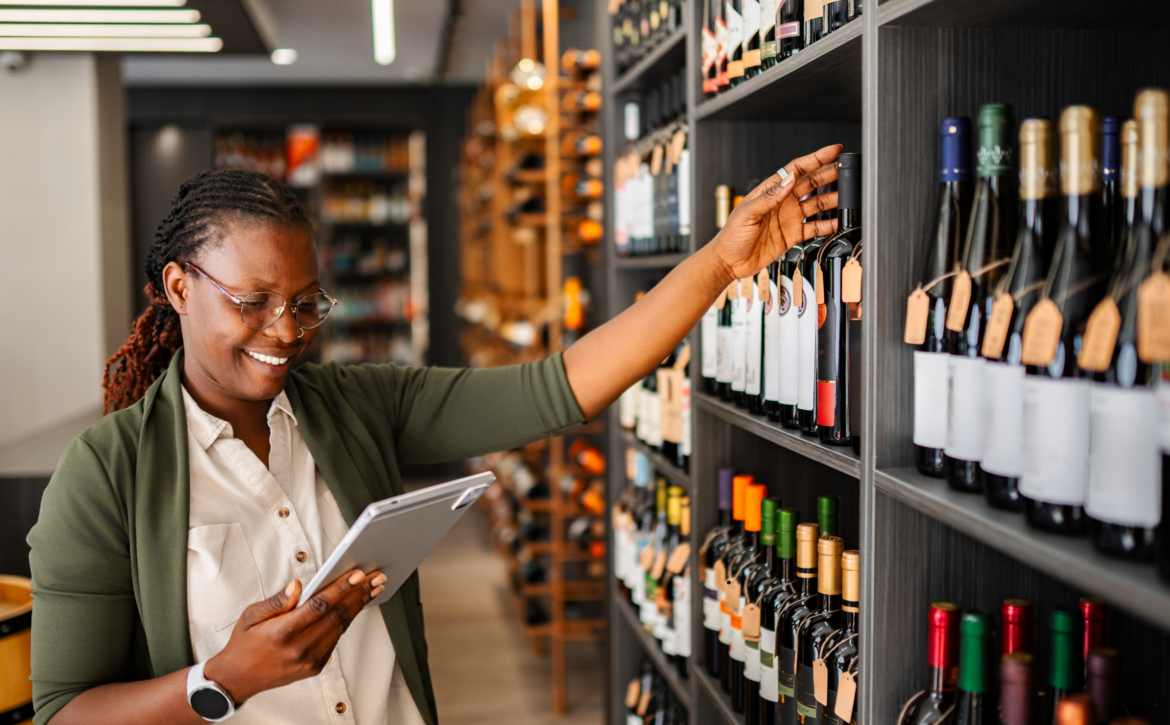
Woman with digital tablet in hand standing in sales floor of liquor store.

The stores that benefit most from this change will be the ones engaging directly with local hospitality operators in their area, not waiting for orders to come in. That starts with real conversations about what’s actually hard to source or frequently out of stock, what specialty products a restaurant or bar would carry more of if availability were reliable, and what they’d buy locally if faster delivery were an option. Conversations like these will shape a store’s product strategy far more effectively than guessing at demand.

Once those needs are clear, inventory and operations can be adjusted accordingly: refining product selection based on repeat requests, speeding up ordering practices, and in some cases introducing delivery or added storage to meet hospitality-scale demand. The objective is simple: become a reliable local supplier, not just a retail outlet.

Local Flexibility Is the Competitive Advantage

Unlike centralized distribution systems, private liquor stores can move quickly. That flexibility lets operators:

  • Respond faster to local demand shifts
  • Build direct relationships with decision-makers
  • Adjust inventory without long procurement cycles
  • Provide more responsive service to hospitality clients

In a licensee-to-licensee environment, speed and flexibility matter as much as price and product selection.

Rules to Know Before You Start Selling

  • Price cannot go below what the seller paid, which itself cannot be below the LDB’s wholesale price.
  • Every transaction receipt must include both parties’ liquor licence numbers and the purchaser’s name.
  • Authorized sellers may deliver orders directly, but purchasers cannot use a third-party delivery service to receive them, and cannot buy from a retailer located outside BC.
  • Loyalty, incentive, or reward programs are not allowed for sales between licence classes.
  • Both parties must log each transaction in their liquor register and keep records for at least six years.

Frequently Asked Questions

Which liquor stores can sell to hospitality businesses under this trial?

Licensee retail stores, wine stores, special wine stores, and rural licensee retail stores are the authorized sellers under the trial.

Which businesses can buy from a private liquor store under this trial?

Liquor primary licensees, liquor primary club licensees, food primary licensees, catering licensees, and manufacturer licensees with a lounge endorsement can purchase directly.

Is this a permanent change?

Not yet. It’s a three-year trial running until June 1, 2029. The LCRB will monitor the impact and use the findings to inform any future decision about making it permanent.

Do I need to apply to participate?

No. Eligible licence classes are automatically authorized to sell or buy under the trial; no application to the LCRB is required.

Can I deliver orders to hospitality customers?

Yes, authorized sellers may deliver directly. Purchasers, however, are not permitted to use a third-party delivery service to receive these orders.

Turning This Into a Structured Revenue Stream

This is a sales channel, not just a policy change. Operators who treat it as a structured hospitality sales opportunity will be best positioned to grow revenue; those who do not engage will likely see limited impact.

Licensee-to-licensee sales give private liquor stores a real, if time-limited, opportunity to diversify revenue beyond the retail counter. The trial runs until 2029, and how much a store benefits will depend largely on how deliberately it approaches the opportunity now.

Rising Tide Consultants works with private liquor store operators across British Columbia to identify hospitality opportunities and build practical systems for licensee-to-licensee sales. If you’re looking to turn this regulatory change into a structured revenue stream, we can help.

Read More

Can a BC Liquor Store Licence Be Relocated Temporarily? First-Ever Approval Sets a Precedent

For years, private liquor stores in British Columbia had few options when their leased premises were slated for redevelopment. If the building was coming down, the business often had to close until construction was complete.

That has now changed. A new provincial policy allows eligible private liquor stores to temporarily relocate while redevelopment is underway, giving operators the opportunity to continue serving customers instead of shutting their doors, and BC has just approved its first case under this new policy.

Key Takeaways

  • A BC liquor store licence is tied to a specific, licensed address, not the business itself, and it isn’t automatically transferable if that address changes.
  • Until recently, private liquor stores facing redevelopment had few options beyond closing until construction was complete.
  • A new provincial policy now allows eligible stores to temporarily relocate nearby while their original site is redeveloped.
  • Rising Tide Consultants helped secure the first approved case under this policy, working with Darby’s Liquor Store at 2918 W 4th Ave in Vancouver. Their original site is now an active construction zone, with 62 housing units being built above, while Darby’s Liquor Store will occupy the ground floor below.
  • Temporary relocation approval depends on the specific circumstances of the business and to ensure the proposed location satisfies Branch criteria. There is a process involved.

What Is a BC Liquor Store Licence?

liquor store manager

A BC liquor store licence is issued and regulated by the Liquor and Cannabis Regulation Branch (LCRB), and it’s tied to a specific physical address rather than to the business itself. That distinction matters more than it might seem: if the licensed address goes away, whether through redevelopment, an expired lease, or a forced move, the licence doesn’t automatically travel with the business. That’s exactly what has historically made redevelopment such a difficult situation for liquor store operators.

Can a BC Liquor Store Licence Be Relocated?

Historically, the answer was effectively no, not without significant disruption. If a liquor store’s building was slated for redevelopment, the operator generally had to close and reapply once a new location was secured, often losing months of revenue along the way.

A new provincial policy has changed that. Eligible private liquor stores can now apply to temporarily relocate while redevelopment is underway, allowing the business to keep serving customers from a nearby location instead of shutting down entirely.

BC’s First Approved Temporary Liquor Store Relocation

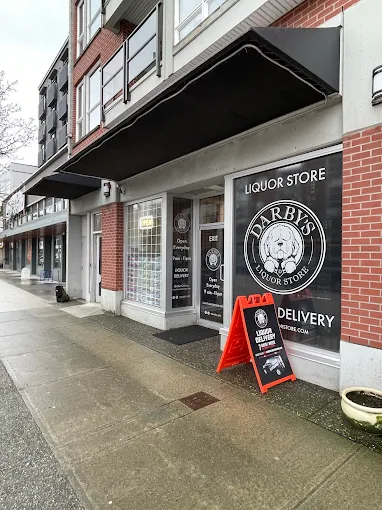
Darby's Liquor Store in Vancouver

Rising Tide Consultants is proud to have helped secure the first approval under this new policy. Working with Darby’s Liquor Store in Vancouver, our team successfully challenged an earlier decision and navigated the application process, resulting in BC’s first approved temporary relocation for a private liquor store. The store was able to move to a nearby location and continue operating while its original site is redeveloped.

This approval does more than help one business. It establishes a practical pathway for other liquor retailers facing redevelopment to keep operating while major construction projects are underway.

What to Know Before You Apply

Temporary relocations won’t be available in every situation. Like any liquor licence application, approval depends on the specific circumstances of the business and the proposed temporary location. But this policy provides a valuable new option for operators who previously had very few.

Frequently Asked Questions

Does every BC liquor store qualify for temporary relocation?

No. Approval depends on the specific circumstances of the business and the proposed temporary location, the same way it would for any other liquor licence application.

Is this policy available outside of British Columbia?

This particular policy is specific to the LCRB in British Columbia. Whether an equivalent option exists in other provinces would need to be confirmed with that province’s liquor regulator, since processes and policies vary.

What happens if my liquor store’s building is being redeveloped?

Options can include applying for a temporary relocation if you’re eligible, coordinating timing with the developer, or planning for a new permanent location. A review of your specific circumstances is the best starting point before assuming any one path is your only option.

How long does a temporary relocation approval take?

Timelines depend on the specific circumstances of the application and the LCRB’s review process. Because this is a newly established pathway, there isn’t yet a standard processing benchmark to point to.

What This Means for BC Liquor Retailers Facing Redevelopment

A BC liquor store licence doesn’t have to mean starting over every time your building changes hands or comes down for redevelopment. This approval shows there’s now a practical path to keep operating through it.

The vast majority of liquor stores, both private and LDB, operate on leased properties. In today’s market, where demand for housing and redevelopment is strong, landlords are increasingly looking at the “highest and best use” of their properties. The ability to temporarily relocate your store during a redevelopment project allows you to:

  • Maintain revenue and continue serving your customers.
  • Avoid laying off staff.
  • Maintain your delivery business, which would otherwise be lost if the store were forced to close.

If your liquor store is facing redevelopment and you’re unsure what options are available, Rising Tide Consultants can help you assess whether a temporary relocation may be possible and guide you through the application process.

Read More
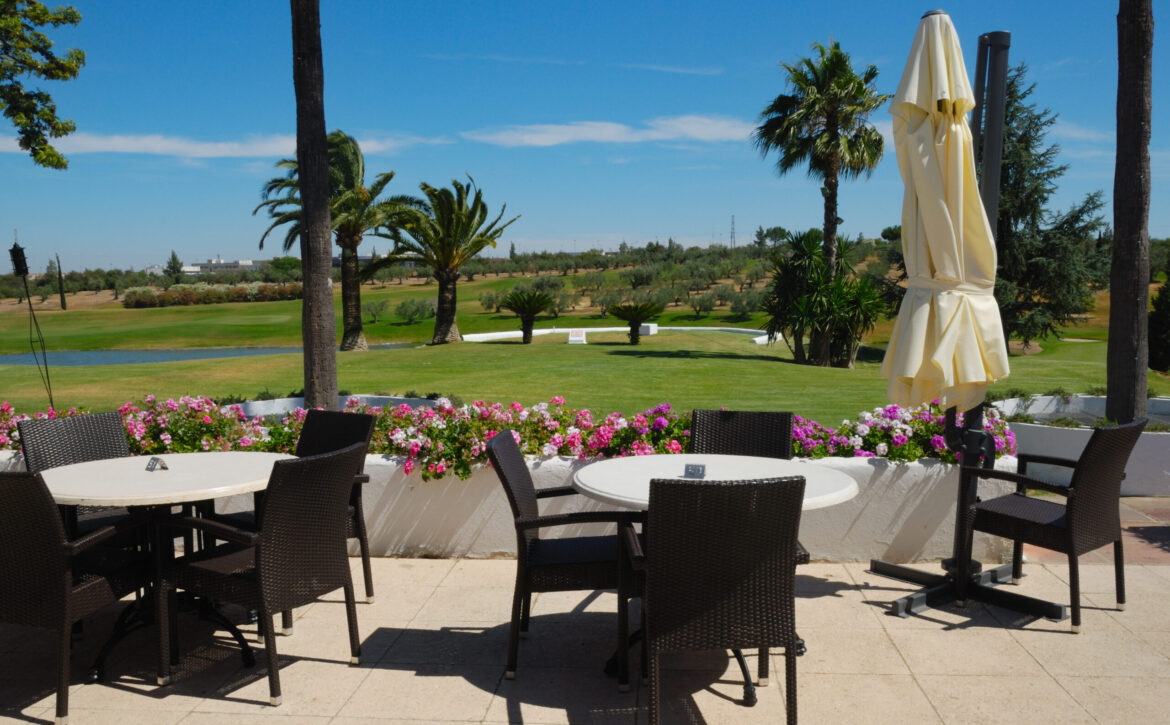
Snack bar in golf course in Andalusia, Spain

Golf Course Liquor Licence: Is Yours Keeping Up With How You Actually Operate?

Many golf courses and country clubs are pouring and serving drinks in spaces their liquor licence was never updated to cover. The clubhouse might have been renovated, the practice facility expanded, or a simulator bay added, but the licence itself often still reflects the property as it operated years ago.

A golf course liquor licence spells out exactly what your business is authorized to do: which areas can serve alcohol, during what hours, and under what type. For golf courses across Canada, the gap between that document and day-to-day operations is more common than most boards realize, and it can mean lost flexibility, missed revenue, or unnecessary compliance risk.

Key Takeaways

  • A liquor licence is tied to specific areas, hours, and type. It does not update automatically when a golf course or country club renovates or expands.
  • Driving ranges, practice facilities, simulator bays, and patios are commonly left out of a golf course’s licensed footprint.
  • Some courses aren’t missing areas at all, they’re operating under a licence type or structure that no longer fits how the property runs today.
  • Comparing your current licence to how the property operates today is the fastest way to spot a gap.
  • Updating a licence can unlock additional service areas and operational flexibility without changing how the course is run day to day.
  • Licensing bodies and processes differ by province (LCRB in BC, AGLC in Alberta, AGCO in Ontario), but the underlying question is the same everywhere: does your licence match your operation?

What Is a Golf Course Liquor Licence?

Golf ball with glass of beer are on green grass

A golf course liquor licence is the provincial authorization that allows a golf course, country club, or golf club to sell and serve alcohol on its property. The licence sets out exactly which areas are covered, such as the clubhouse, patio, or pro shop, along with permitted hours and the licence type. Requirements and licensing bodies vary by province, including the LCRB in British Columbia, the AGLC in Alberta, and the AGCO in Ontario, but every golf course serving alcohol needs a licence that matches how the property is actually used.

Why Do Golf Course Liquor Licences Fall Behind?

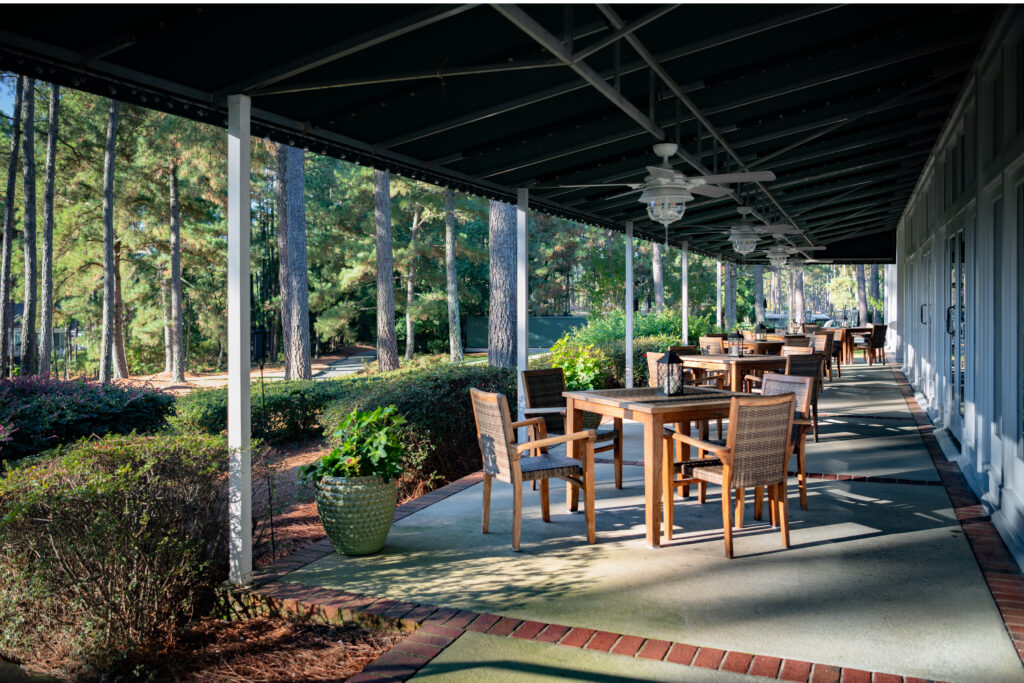
Golf course country club resort lifestyle

Liquor licences are usually set when a course first opens or completes a major renovation. From that point, the licence stays fixed unless someone actively applies to amend it. Golf courses, on the other hand, keep evolving: adding simulator bays, expanding patios, building out banquet space, or introducing on-course beverage service.

Because none of those changes trigger an automatic licence update, it is easy for a board or General Manager to assume that because members have “always been served there,” the area must be licensed. In practice, service can outpace the paperwork for years before anyone checks.

What Areas Are Commonly Missing From a Golf Course’s Licence?

Every property is different, but a few areas come up repeatedly during golf course and country club licence reviews:

  • Driving ranges and practice facilities
  • Simulator spaces and indoor practice bays
  • Patios and outdoor seating added after the original licence was issued
  • Other areas that may be eligible for licensing but were never included in the original application

It isn’t always a missing-area problem. Some courses have every space covered on paper but are operating under a licence type or structure that no longer suits how the property actually runs, which a straightforward area count won’t catch.

How Do You Know If Your Licence Needs Updating?

The most direct way to check is to compare your current licence, the licensed areas, hours of service, and licence type, against how the property actually operates today: clubhouse service, patio hours, simulator or practice-facility use, and event bookings. Any mismatch between the two is a sign the licence is out of date.

This usually surfaces after a renovation or expansion, ahead of a large tournament or private event season, during a change in management or ownership, or simply as a periodic check to confirm nothing has drifted out of compliance.

What Are the Benefits of Updating Your Licence?

  • Members and guests can be served in the areas they already expect, without ambiguity
  • Lower compliance risk during inspections or if a complaint is ever filed
  • More flexibility for tournaments, private events, and banquet bookings
  • A licence that matches the property instead of restricting how patio and on-course service can be offered

Real-World Example

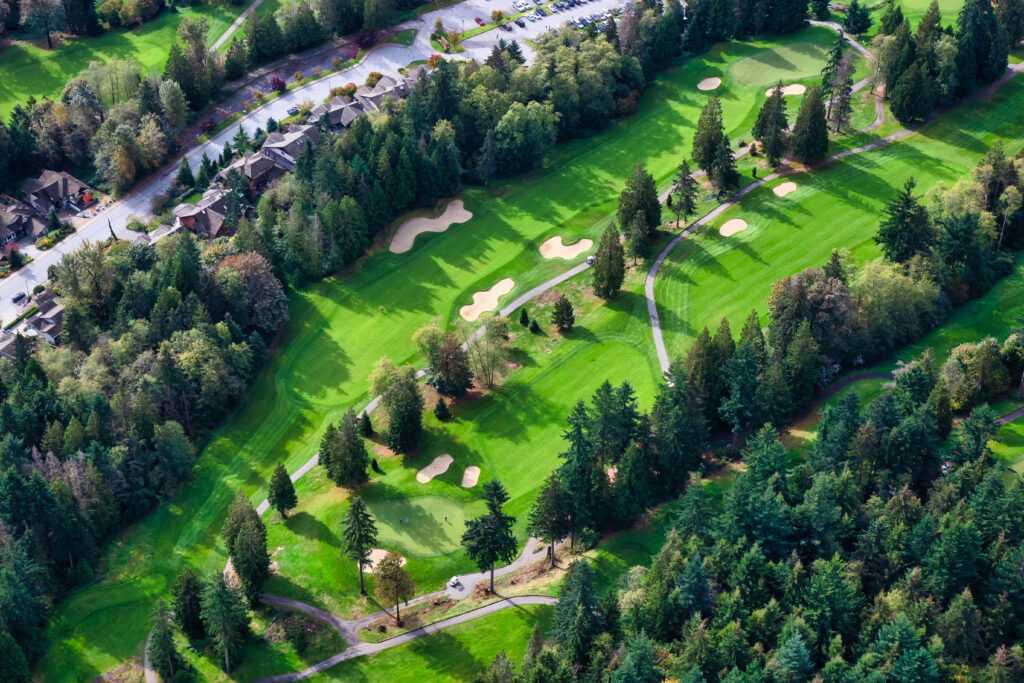
Aerial view on the Golf Course in residential neighbourhood

A recent project for a Lower Mainland golf club, operating under a liquor licence in BC, resulted in an expanded licensed area that now includes additional clubhouse spaces, practice facilities, and portions of the golf course. The updated licence better reflects how the club serves its members and provides greater flexibility for day-to-day operations.

Every golf course is different, and the options available depend on the property, the existing licence, and the club’s operational needs. A review is simply the process of finding out what is possible before assuming the current licence is the ceiling.

Common Mistakes Golf Courses Make With Their Liquor Licence

Assuming Renovations Carry the Licence With Them

A new patio, expanded pro shop, or simulator bay does not become licensed just because it is adjacent to a licensed area. Each addition needs to be assessed against the existing licence.

Treating the Licence as a One-Time Task

A liquor licence is not a “get it and forget it” document. Courses that treat it that way are more likely to discover a gap during an inspection rather than on their own terms.

Waiting Until an Event or Inspection Forces the Issue

Reviewing a licence ahead of a tournament, wedding season, or membership drive is far easier than trying to fix a gap once it has already been flagged by a regulator or a complaint.

Why This Isn’t Just a BC Issue

As golf courses and country clubs invest in simulator lounges, expanded practice facilities, and private event and wedding bookings, the same licence-versus-operations gap can show up anywhere in Canada, not only in BC.

Licensing bodies and terminology differ by province, the LCRB in British Columbia, the AGLC in Alberta, and the AGCO in Ontario, but the core issue is consistent from coast to coast: licences are static documents, and golf courses are not.

Frequently Asked Questions

Do golf courses need a special liquor licence?

Yes. Golf courses, country clubs, and golf clubs that serve alcohol need a liquor licence that covers the specific areas being served, whether that is the clubhouse, patio, halfway house, or on-course service. Licence classes and requirements for a golf course liquor licence vary by province.

How do I know if my golf course’s liquor licence needs updating?

If the property has added or renovated spaces, such as a driving range, simulator bays, a patio, or an event space, since the licence was last reviewed, there is a good chance the licence does not reflect the current footprint.

We will review your existing licence at no cost and advise you on any changes that may be needed or could help increase your revenue.

Does updating a liquor licence disrupt current operations?

Not typically. Most reviews and amendments can be planned and processed without pausing existing licensed service.

Is this only relevant for golf courses in British Columbia?

No. While the regulator and process differ by province, the underlying issue, licences falling out of step with how a property actually operates, applies to golf courses, country clubs, and private clubs every Province.

Bringing Your Golf Course’s Liquor Licence Up to Date

A liquor licence review does not require changing how a course operates. It simply confirms whether the paperwork matches the reality on the ground, and identifies the options available if it does not.

Rising Tide Consultants has worked with hospitality operators across Canada since 1988 to review, expand, and maintain liquor licences that keep pace with how a business actually runs. If your golf club has grown, renovated, or added new amenities since your licence was last reviewed, our team can help you assess what is possible.

Read More

Cannabis Licensing Consultants of the Year 2024

Rising Tide Consultants has been awarded Cannabis Licensing Consultants of the Year 2024 from Cannabis Business Insights! Our Founder and President, Bert Hick, was interviewed for a feature article in the current issue. 

“The people who regulate liquor are often the same individuals now overseeing cannabis at municipal and provincial levels,” Hick explains. “Our familiarity with them prepares us to guide upcoming cannabis businesses through every stage of their licensing, compliance and ongoing regulatory challenges.”

[Rising Tide Consultants] bridges the gap between government oversight and business operations, providing clients with guidance that is both practical and legally sound.

From Red Tape to Green Light

In Canada, a cannabis license—whether for retail, cultivation or processing—is considered a privilege, not a right. This fundamental principle underscores the rigorous scrutiny applied to every application, especially in British Columbia, where regulators are known for their cautious and thorough approach. The complex, multi-layered approval process involves the local government, the provincial government and sometimes even the B.C. Provincial Agricultural and Land Commission.

Hick’s approach to navigating this maze is refreshingly holistic. 

“It’s about knowing the people, policies, regulations and how to position an application,” Hick states. “We address the issues upfront, so when decision-makers review it, everything falls into line.”

Read full article here

Read More

Exciting New Design Service Offered by Rising Tide Consultants

Rising Tide Consultants is pleased to announce that we offer design services to support our valued clients! By providing professionally drafted floor plans in AutoCad or Sketchup, you no longer need to engage an outside designer or pay your architect to do your floor plan drawings. This allows you to save time and money by streamlining the design process in presenting your drawings for your architect’s approval and facilitating a smooth submission to the city.

Rising Tide’s very own Meagan Morris completed the Residential Interiors program (DDA) at the University of Alberta and has extensive experience designing for residential and commercial projects across North America.

We are currently working on multiple projects for premiere Downtown Vancouver hotel locations. Get in touch to see how we can assist with your design needs.

Read More

Let’s Keep Vancouver Safe!

We all love to cheer on our Canucks during the playoffs, but we are urging our clients to remember to create a safe and compliant environment for their patrons this season.

Responsible alcohol service is essential in keeping our city safe for these upcoming celebrations, so please be vigilant in enforcing your liquor service policies and ensure that proper ID practices are always adhered to.

Remember if you are caught serving alcohol to a minor you will be fined $7,000 on the spot! Over-service is a key factor in situations escalating to a point no one wants to see, so watch your guest’s consumption closely.

Alcohol products purchased to-go must be accompanied by a meal, and by this we mean not just a bag of chips. Want to know what constitutes a “meal” in this instance? Give us a call

Both the VPD and inspectors from the LCRB will be out in full force during the games so be sure to have the following items up to date and ready to show if they pay you a visit:

  • Serving it Right certificates for all serving staff
  • Your liquor & business license posted correctly
  • Current floor plan
  • Liquor register
  • Alcohol Sense Materials
  • Policy & Procedures Manuals that outline responsible liquor service

Missing some items? Have questions about getting this all organized in time? We are here to help!

Let’s all work cooperatively with our enforcement teams that are working hard to protect the citizens of Vancouver and prioritize mindful service and safety practices so that we can have a fun, successful Stanley Cup playoff season!

Read More
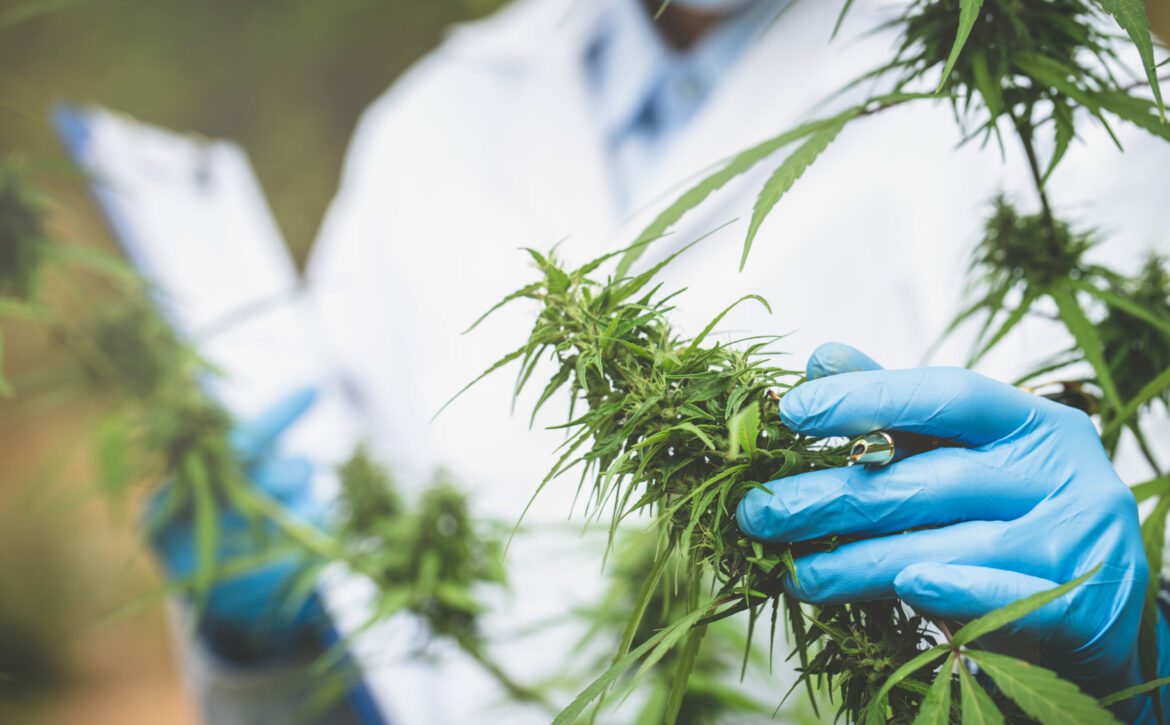
Marijuana Researcher, Female scientist in a hemp field checking plants and flowers, alternative herbal medicine concept.

Minors as Agents Program (MAP) Costing Cannabis Stores Thousands of Dollars in Fines!

The Government Minors as Agents Program is targeting Cannabis Stores and if you are caught in non-compliance, it will cost you thousands of dollars!


The team at Rising Tide Consultants travels across the province to audit the existing policies and procedures of cannabis stores to ensure they have the best defence of due diligence in cases of compliance or enforcement issues. We then provide a comprehensive report detailing any inefficiencies found during the onsite visit and suggestions to resolve any potential issues.


We also offer presentations to cannabis store staff on how the MAP works. This ensures they know what to expect and look for in the “setup” of the trap and forewarning and how to set the team up for success if they are targeted.


The Branch is sending minors into cannabis establishments to see if they can catch staff members selling cannabis to a minor. If the minor is caught just on the premises, even without a transaction, the fine could be $3,000 to $7,000.This can be compounded if the minor is successful in purchasing cannabis without being asked for ID, with an additional penalty of $7,000 to $11,000. If the business is caught in non-compliance again, it could result in a potential 11-day suspension of their license or a $7,000 to $11,000 fine for having a minor on the premises and a $11,000 to $15,000 fine for a minor purchasing cannabis. There are even higher penalties for a 3rd offence!

Rising Tide Consultants can provide you with informative resources to help you stay one step ahead of the Branch.


Reach out to us if you would like our help to avoid the harsh penalties of the Minors as Agents Program. 

Read More

‘SAVE BC RESTAURANTS’ IS ACKNOWLEDGED BY GOVERNMENT 

The Honourable Brenda Bailey – Minister of Jobs, Economic Development and Innovation, speaks on the SAVE BC RESTAURANTS campaign:

“The first thing I want to say about the restaurant sector and their save B.C. restaurants campaign is: “Well done.” I think it was one of the most inventive campaigns that I’ve seen. The communications were very strong. I congratulate the restaurant sector for really quite a well-designed and engaging campaign.“

“Another request that the restaurant sector put in front of us was they had the experience that they had to go to a number of different ministers and lobby each individually on particular challenges that they were experiencing. They identified that it would be much better for them should they just have one contact. And so that’s something that we have put in place. That contact is Minister Popham. “

“The Solicitor General, the Minister for Tourism, Arts and Culture and myself will be working together on challenges that the restaurants faced, but it is the Minister of Tourism, Arts and Culture who is the number one contact. Then the information will share out that way.”

“But I do just want to really highlight that in addition to the many supports we put in place throughout the pandemic and since the number one request, the most important thing — and the restaurant sector really drove this home — was to change the EHT. I’m so grateful that we were able to do that for them.“

The EHT (Employer Health Tax) payroll threshold will be moved from 1/2 million to 1 million which will exempt a lot of small businesses from having to pay this tax. A very positive win for Industry!

Read More

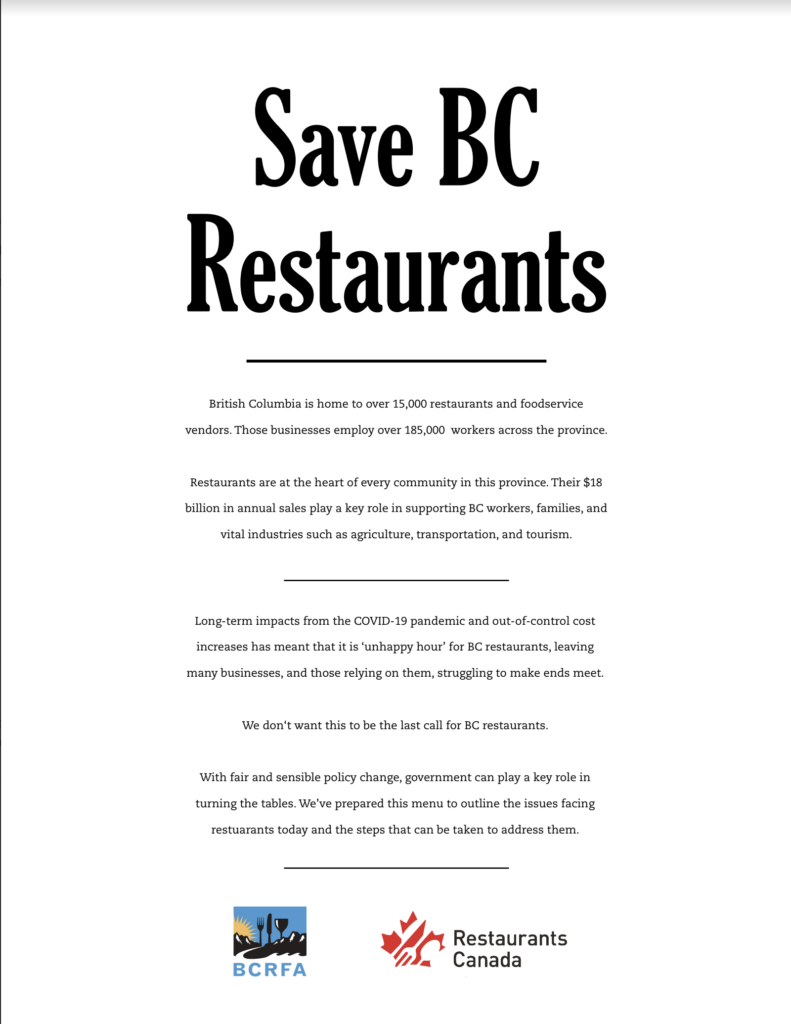
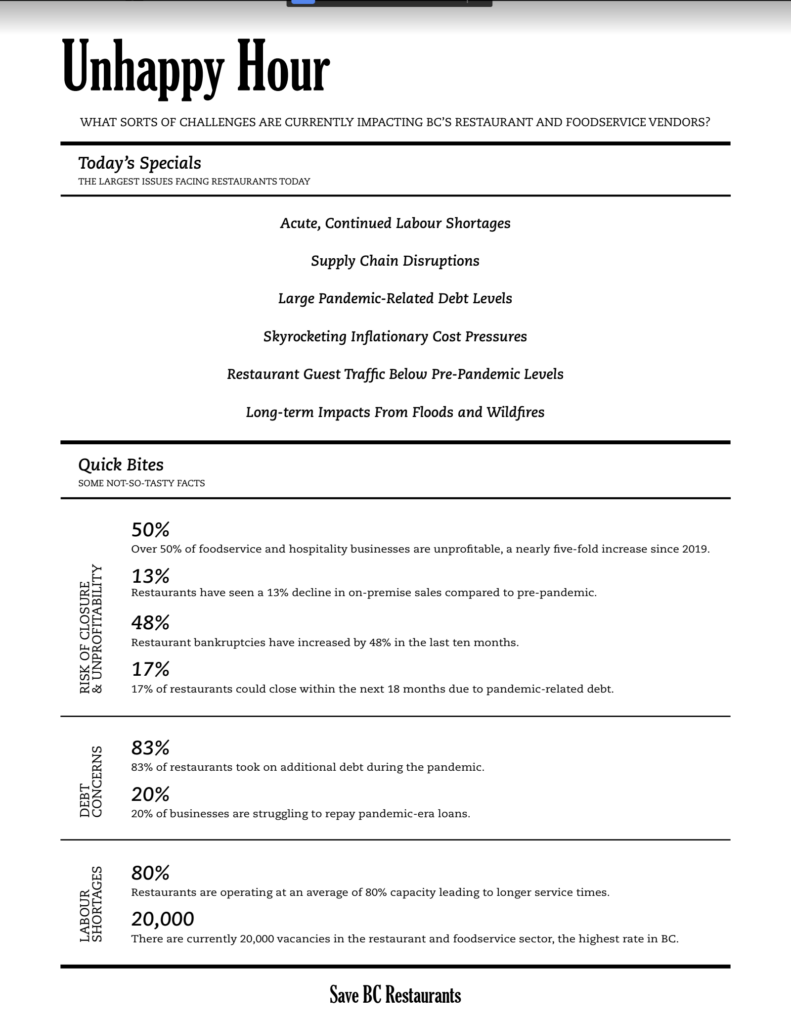
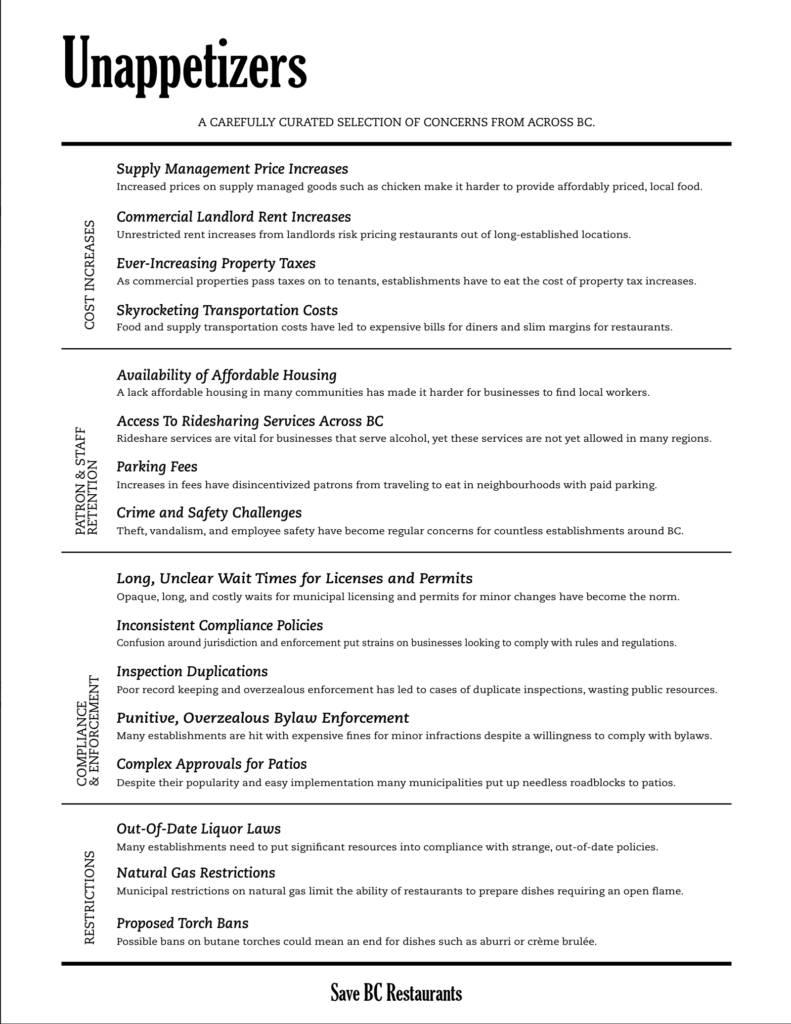
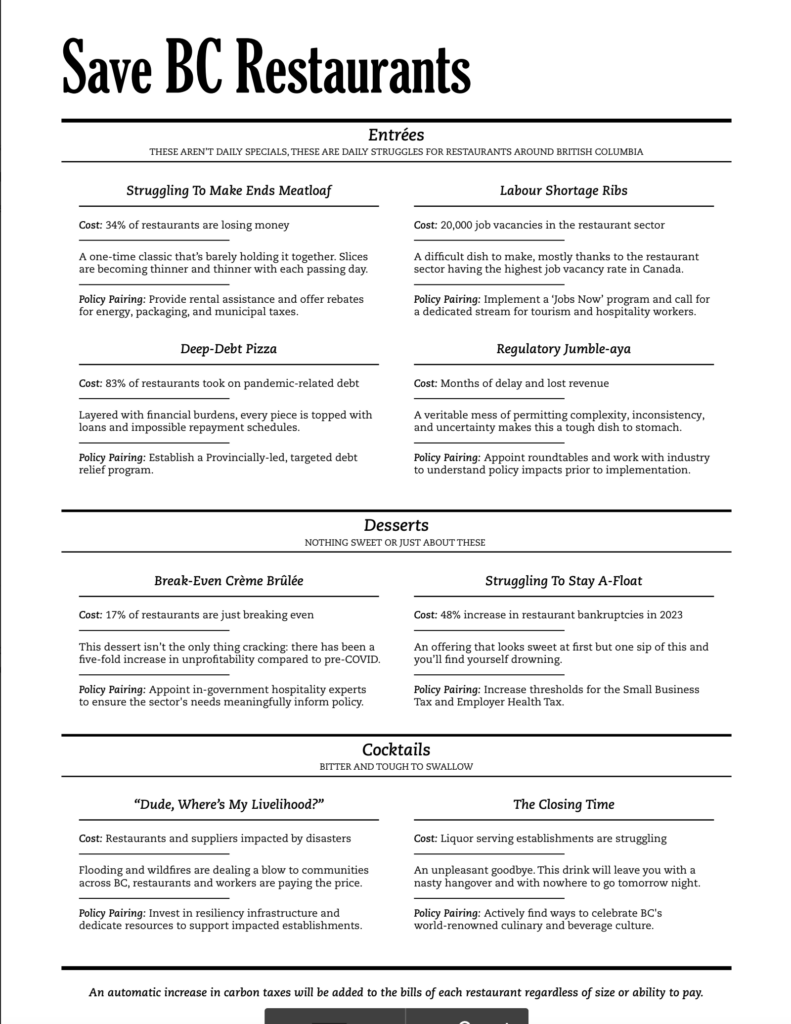
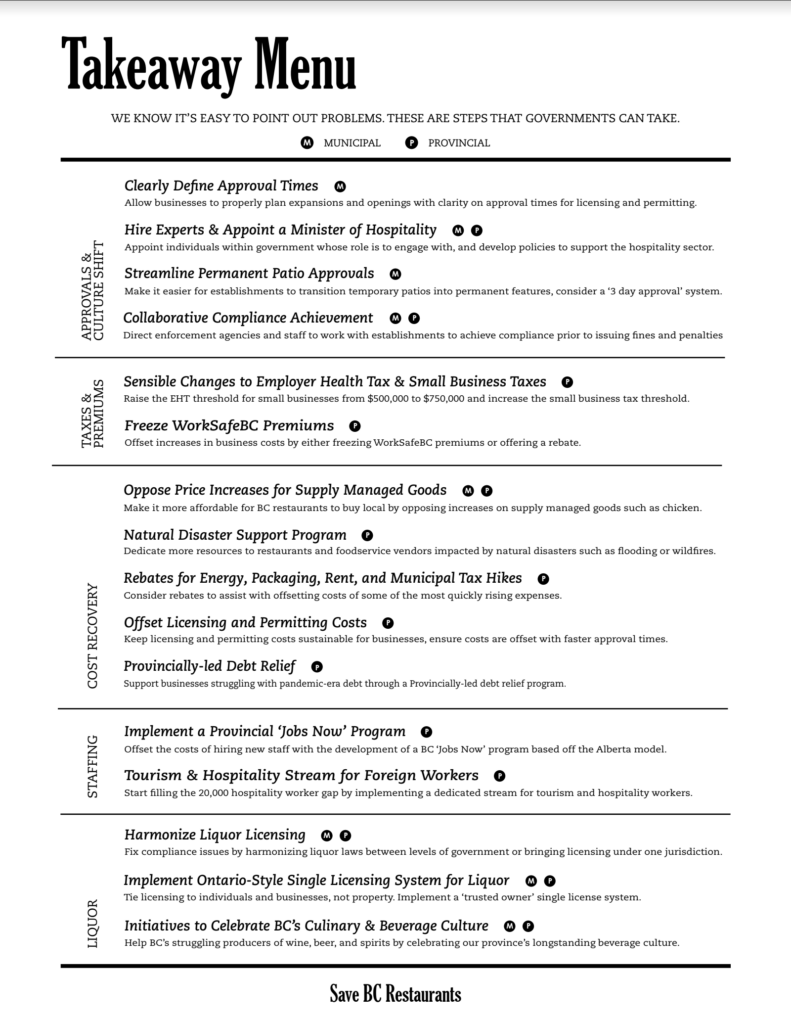
Save BC Restaurants!

This is a Crisis.

The Restaurant Industry is facing countless challenges and the BCRFA and Restaurants Canada have come together to show the Government that when you stack challenge after challenge, cost increase after cost increase, over debilitating debt from loans, the picture is a serious one and not easy to read.

“The Menu” below is being introduced to Government bodies, the press and the public on Tuesday, January 23, 2024, with the hopes that seeing everything that Restaurants face in one intense document will help people understand the severity of what Restaurants are going through.

It is our hope that “The Menu” will show the truth of the crushing impacts of what Restaurants deal with on a daily basis and encourage real support and understanding from our Government so that change will be imminent. 

Read More
×